Try it
Copy the code ↓- Data source
- Decision schema
- Model inference
- Structured result
2 Decision schema 3 typed questions
ruling_fitchoicecoversresembles_onlygoes_furtherunrelatedcoversnoulprobability 0–1same_guidelinenoulprobability 0–1
3 Model inference typesafe/jev-1.13
Waiting for a run.
4 Structured result
Raw JSON
Run the demo to see the JSON answers, the highlighted pick and the final action.
FLATKEY_API_KEY and run.curl -sS https://router.flatkey.ai/api/alpha/decisions \
-H "Authorization: Bearer $FLATKEY_API_KEY" \
-H "Content-Type: application/json" \
-d '{
"model": "typesafe/jev-1.13",
"state": "Finding: Error envelope rule. API handlers must return the team error envelope, not a bare error object.\n\nHunk:\n--- a/tests/fixtures/payments_stub.py\n+++ b/tests/fixtures/payments_stub.py\n@@ -12,6 +12,9 @@ def charge(request):\n if request.headers.get(\"x-simulate-failure\"):\n- return JSONResponse({\"ok\": False}, status_code=500)\n+ return JSONResponse({\"error\": \"failed\"}, status_code=500)\n return JSONResponse({\"ok\": True, \"charge_id\": \"ch_test_123\"})\n\nRuling: Error envelope rule: fixtures under tests/ are exempt, because they never ship.\n\nTask: ruling_fit, covers, same_guideline.",
"questions": {
"ruling_fit": {
"type": "choice",
"instructions": "A code-review check flagged `hunk` under the guideline named in `finding`. Read the reviewer ruling in `ruling` literally, including its scope and reason. How does the ruling relate to this hunk?",
"criteria": {
"covers": "The hunk is squarely inside the scope the ruling names, for the same guideline, and the ruling'\''s reason applies to it",
"resembles_only": "The hunk looks like the case the ruling was written for, but its path, purpose or context is outside the stated scope",
"goes_further": "The hunk is partly in scope but does more than the ruling allows, for example code that is imported by something that ships",
"unrelated": "The ruling is about a different guideline, a different part of the codebase, or a different kind of change"
}
},
"covers": {
"type": "noul",
"instructions": "Does the ruling in `ruling` cover `hunk` exactly as the ruling states its scope?",
"criteria": {
"true": "The hunk is squarely inside the scope the ruling names.",
"false": "The hunk is outside that scope, only resembles it, or goes further than the ruling allows."
}
},
"same_guideline": {
"type": "noul",
"instructions": "The ruling is about the same guideline the finding was raised under."
}
}
}'// Node.js 18+ (built-in fetch). Run: FLATKEY_API_KEY=... node jev.mjs
const body = {
"model": "typesafe/jev-1.13",
"state": "Finding: Error envelope rule. API handlers must return the team error envelope, not a bare error object.\n\nHunk:\n--- a/tests/fixtures/payments_stub.py\n+++ b/tests/fixtures/payments_stub.py\n@@ -12,6 +12,9 @@ def charge(request):\n if request.headers.get(\"x-simulate-failure\"):\n- return JSONResponse({\"ok\": False}, status_code=500)\n+ return JSONResponse({\"error\": \"failed\"}, status_code=500)\n return JSONResponse({\"ok\": True, \"charge_id\": \"ch_test_123\"})\n\nRuling: Error envelope rule: fixtures under tests/ are exempt, because they never ship.\n\nTask: ruling_fit, covers, same_guideline.",
"questions": {
"ruling_fit": {
"type": "choice",
"instructions": "A code-review check flagged `hunk` under the guideline named in `finding`. Read the reviewer ruling in `ruling` literally, including its scope and reason. How does the ruling relate to this hunk?",
"criteria": {
"covers": "The hunk is squarely inside the scope the ruling names, for the same guideline, and the ruling's reason applies to it",
"resembles_only": "The hunk looks like the case the ruling was written for, but its path, purpose or context is outside the stated scope",
"goes_further": "The hunk is partly in scope but does more than the ruling allows, for example code that is imported by something that ships",
"unrelated": "The ruling is about a different guideline, a different part of the codebase, or a different kind of change"
}
},
"covers": {
"type": "noul",
"instructions": "Does the ruling in `ruling` cover `hunk` exactly as the ruling states its scope?",
"criteria": {
"true": "The hunk is squarely inside the scope the ruling names.",
"false": "The hunk is outside that scope, only resembles it, or goes further than the ruling allows."
}
},
"same_guideline": {
"type": "noul",
"instructions": "The ruling is about the same guideline the finding was raised under."
}
}
};
const res = await fetch("https://router.flatkey.ai/api/alpha/decisions", {
method: "POST",
headers: {
Authorization: `Bearer ${process.env.FLATKEY_API_KEY}`,
"Content-Type": "application/json",
},
body: JSON.stringify(body),
});
if (!res.ok) throw new Error(`Jev request failed: ${res.status} ${await res.text()}`);
const { answers, usage } = await res.json();
console.log(JSON.stringify(answers, null, 2), usage);# Python 3.8+ (pip install requests). Run: FLATKEY_API_KEY=... python jev.py
import json, os, requests
body = json.loads(r"""{
"model": "typesafe/jev-1.13",
"state": "Finding: Error envelope rule. API handlers must return the team error envelope, not a bare error object.\n\nHunk:\n--- a/tests/fixtures/payments_stub.py\n+++ b/tests/fixtures/payments_stub.py\n@@ -12,6 +12,9 @@ def charge(request):\n if request.headers.get(\"x-simulate-failure\"):\n- return JSONResponse({\"ok\": False}, status_code=500)\n+ return JSONResponse({\"error\": \"failed\"}, status_code=500)\n return JSONResponse({\"ok\": True, \"charge_id\": \"ch_test_123\"})\n\nRuling: Error envelope rule: fixtures under tests/ are exempt, because they never ship.\n\nTask: ruling_fit, covers, same_guideline.",
"questions": {
"ruling_fit": {
"type": "choice",
"instructions": "A code-review check flagged `hunk` under the guideline named in `finding`. Read the reviewer ruling in `ruling` literally, including its scope and reason. How does the ruling relate to this hunk?",
"criteria": {
"covers": "The hunk is squarely inside the scope the ruling names, for the same guideline, and the ruling's reason applies to it",
"resembles_only": "The hunk looks like the case the ruling was written for, but its path, purpose or context is outside the stated scope",
"goes_further": "The hunk is partly in scope but does more than the ruling allows, for example code that is imported by something that ships",
"unrelated": "The ruling is about a different guideline, a different part of the codebase, or a different kind of change"
}
},
"covers": {
"type": "noul",
"instructions": "Does the ruling in `ruling` cover `hunk` exactly as the ruling states its scope?",
"criteria": {
"true": "The hunk is squarely inside the scope the ruling names.",
"false": "The hunk is outside that scope, only resembles it, or goes further than the ruling allows."
}
},
"same_guideline": {
"type": "noul",
"instructions": "The ruling is about the same guideline the finding was raised under."
}
}
}""")
res = requests.post(
"https://router.flatkey.ai/api/alpha/decisions",
headers={"Authorization": f"Bearer {os.environ['FLATKEY_API_KEY']}"},
json=body,
timeout=60,
)
res.raise_for_status()
data = res.json()
print(json.dumps(data["answers"], indent=2), data.get("usage"))No Flatkey key yet? Get one for Jev 1.13 →
About this use case
Who / when
Audience
- teams running an automated code-review check that people keep dismissing by hand
- builders of semantic linting on Jev who need reviewer corrections to stick
- platform teams that store team rules and past rulings in a knowledge base or memory store
- anyone whose decision model cannot be fine-tuned and must carry corrections in the request
Triggers
- the same finding is raised on the third pull request this week after a reviewer already dismissed it
- a reviewer writes "fixtures under tests/ are exempt" in a comment the check never reads
- stuffing every rule and every past ruling into one request makes the judgment worse
- a ruling written too broadly starts exempting code it was never meant to cover
The workflow
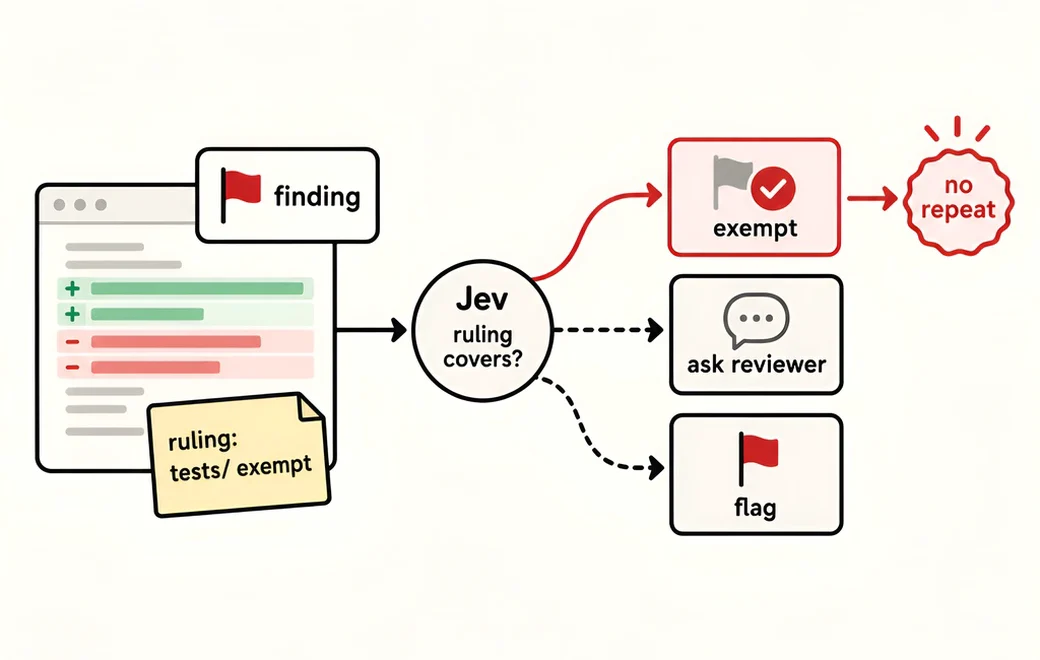
- 01Hunk + findingOne diff hunk with its file path, the guideline it was flagged under, and one stored ruling for that guidelineInput
- 02How does it fit?Covers, only resembles, goes further than allowed, or unrelatedJev
- 03Ruling covers?Yes/no probability that the hunk is squarely inside the ruling's scopeJev
- 04Code gate≥ 0.7 exempt, 0.3–0.7 a person decides, < 0.3 the finding stands; log the ruling usedYour code
Question shape
{
  "ruling_fit": {
    "type": "choice",
    "instructions": "A code-review check flagged `hunk` under the guideline named in `finding`. Read the reviewer ruling in `ruling` literally, including its scope and reason. How does the ruling relate to this hunk?",
    "criteria": {
      "covers": "The hunk is squarely inside the scope the ruling names, for the same guideline, and the ruling's reason applies to it",
      "resembles_only": "The hunk looks like the case the ruling was written for, but its path, purpose or context is outside the stated scope",
      "goes_further": "The hunk is partly in scope but does more than the ruling allows, for example code that is imported by something that ships",
      "unrelated": "The ruling is about a different guideline, a different part of the codebase, or a different kind of change"
    }
  },
  "covers": {
    "type": "noul",
    "instructions": "Does the ruling in `ruling` cover `hunk` exactly as the ruling states its scope?",
    "criteria": {
      "true": "The hunk is squarely inside the scope the ruling names.",
      "false": "The hunk is outside that scope, only resembles it, or goes further than the ruling allows."
    }
  },
  "same_guideline": {
    "type": "noul",
    "instructions": "The ruling is about the same guideline the finding was raised under."
  }
}
Gate policy
covers ≥ 0.7
Exempt the finding in code, post the decision with the ruling that resolved it to the review record, and do not comment on the pull request.
0.3–0.7
Send it to a person (or a reasoning model) with the hunk, the finding and the ruling side by side; save their answer as a new, narrower ruling.
covers < 0.3
The finding stands: post it on the pull request as usual and record that this ruling was checked and did not apply.
Failure modes
Pre-launch checks before you trust auto-routing:
- Keeping reviewer corrections only in pull-request comments, so the check never sees them and raises the same finding on every pull request;
- Putting rulings into the first judging request, so one ruling can quietly change decisions it was never written for;
- Pasting every rule and every past ruling into each request; accuracy drops as the state fills with text unrelated to the decision;
- Writing a ruling without a reason, so it matches look-alike code (a helper imported by something that ships) and exempts it;
- Letting a ruling make a rule stricter or override a block; rulings should only exempt, and stricter rules belong in the guidelines;
- Treating the probability as a verdict with no middle band, so borderline hunks are silently exempted or silently flagged;
FAQ
Why can't the correction just go into the model?
Jev is not fine-tuned on your data. You shape its behavior only through the state and question fields of each request, so a reviewer's correction has to be stored somewhere else, found again for a similar hunk, and sent with the next request.
Why ask about rulings in a second, separate request?
Keeping the guideline judgment and the ruling check apart means a ruling can only change the decision it names. Rulings are looked up only for findings that were not already dropped, and each ruling is checked on its own, one question per ruling.
What should a stored ruling look like?
A fixed shape: the rule's name, the scope, and the reason, for example "Error envelope rule: fixtures under tests/ are exempt, because they never ship." The name lets code find rulings for one rule, and the reason keeps the ruling narrow so it does not exempt look-alike code.
Where do the 0.3 and 0.7 cutoffs come from?
They are the starting bands used in the Yugabyte write-up linked below. Treat them as the first thing to tune: run the check on findings your team has already judged and move the cutoffs until clear cases land in the right band and borderline ones land in the middle.
What does the Flatkey call look like?
POST https://router.flatkey.ai/api/alpha/decisions with Authorization: Bearer …, Content-Type: application/json, and a body of state (hunk, finding, ruling), model (typesafe/jev-1.13), and questions (choice / noul). This is not an OpenAI-compatible /v1 chat endpoint. Get a key for Jev 1.13 on Flatkey.
Can I bring my own API key?
Yes. Try the free demo above without signing in. To run it live on your own text, sign in with Google and connect a Flatkey or OpenRouter key (a quick test call runs when you save it). Manage or delete it anytime under Dashboard → BYOK. Keys are stored encrypted on the server, used only for runs you trigger, and never sent back to the browser. Need a Flatkey key? Get one for Jev 1.13 on Flatkey.
Is this the official TypeSafe Jev product page?
No. jev-llm.com is an independent research and practice site. Verify pricing, models and terms at the original TypeSafe sources.
Sources
When a #Jev-powered check gets something wrong, and a person corrects it, where does that correction go, and how can you ensure the correction is implemented in future results? 🤔 This new blog from Yugabyte expert @quorralyne explains why a decision model #correction should live outside the model, what a system needs to ensure corrections carry into the next request, and the #codereviewcheck that prevents the system from raising a finding after a reviewer has overruled it. 💡
— @Yugabyte View the post on X →
Wire this gate with your own key
Bring your own key through Flatkey / OpenRouter. Keep exact checks in code.