Try it
Copy the code ↓- Data source
- Decision schema
- Model inference
- Structured result
2 Decision schema 3 typed questions
decisionchoicepassretryreviewblockevidence_strengthscorehighmediumlowneeds_humannoulprobability 0–1
3 Model inference typesafe/jev-1.13
Waiting for a run.
4 Structured result
Raw JSON
Run the demo to see the JSON answers, the highlighted pick and the final action.
FLATKEY_API_KEY and run.curl -sS https://router.flatkey.ai/api/alpha/decisions \
-H "Authorization: Bearer $FLATKEY_API_KEY" \
-H "Content-Type: application/json" \
-d '{
"model": "typesafe/jev-1.13",
"state": "CI job: agent-eval-suite #4821 (PR #910)\nEvidence from LLM + harness (not a decision):\n- response_quality: 0.82\n- tool_success_rate: 0.94\n- p95_latency_s: 1.8\n- safety_check: pass\n- flaky_retries_so_far: 0\n\nPolicy:\n- PASS if quality≥0.80, tools≥0.90, latency≤2.0s, safety pass\n- RETRY on transient tool/latency flakes when quality still ok\n- REVIEW when metrics are borderline or conflict\n- BLOCK on safety fail or severe quality drop\n\nTask: typed CI gate — pass / retry / review / block (+ evidence strength, needs_human).\nNote: the LLM produced evidence; apply judgment separately.",
"questions": {
"decision": {
"type": "choice",
"instructions": "Decide the CI/CD gate for this AI test or eval run from the evidence only. Do not ask whether the run is \"good enough\" in free text—pick a typed action the pipeline can enforce.",
"criteria": {
"pass": "Evidence meets the policy bar (quality, tools, latency, safety); safe to proceed or merge",
"retry": "Likely flaky or recoverable (timeouts, transient tool failures); re-run before human review",
"review": "Ambiguous or borderline evidence; a human should inspect before merge",
"block": "Clear policy miss—safety fail, severe quality drop, or hard SLA breach; fail the job"
}
},
"evidence_strength": {
"type": "score",
"instructions": "How strong and consistent is the overall evidence for the gate you chose, ignoring the agent'\''s own confidence wording.",
"criteria": [
"high",
"medium",
"low"
]
},
"needs_human": {
"type": "noul",
"instructions": "A human should review this CI gate before the pipeline allows merge or production promote."
}
}
}'// Node.js 18+ (built-in fetch). Run: FLATKEY_API_KEY=... node jev.mjs
const body = {
"model": "typesafe/jev-1.13",
"state": "CI job: agent-eval-suite #4821 (PR #910)\nEvidence from LLM + harness (not a decision):\n- response_quality: 0.82\n- tool_success_rate: 0.94\n- p95_latency_s: 1.8\n- safety_check: pass\n- flaky_retries_so_far: 0\n\nPolicy:\n- PASS if quality≥0.80, tools≥0.90, latency≤2.0s, safety pass\n- RETRY on transient tool/latency flakes when quality still ok\n- REVIEW when metrics are borderline or conflict\n- BLOCK on safety fail or severe quality drop\n\nTask: typed CI gate — pass / retry / review / block (+ evidence strength, needs_human).\nNote: the LLM produced evidence; apply judgment separately.",
"questions": {
"decision": {
"type": "choice",
"instructions": "Decide the CI/CD gate for this AI test or eval run from the evidence only. Do not ask whether the run is \"good enough\" in free text—pick a typed action the pipeline can enforce.",
"criteria": {
"pass": "Evidence meets the policy bar (quality, tools, latency, safety); safe to proceed or merge",
"retry": "Likely flaky or recoverable (timeouts, transient tool failures); re-run before human review",
"review": "Ambiguous or borderline evidence; a human should inspect before merge",
"block": "Clear policy miss—safety fail, severe quality drop, or hard SLA breach; fail the job"
}
},
"evidence_strength": {
"type": "score",
"instructions": "How strong and consistent is the overall evidence for the gate you chose, ignoring the agent's own confidence wording.",
"criteria": [
"high",
"medium",
"low"
]
},
"needs_human": {
"type": "noul",
"instructions": "A human should review this CI gate before the pipeline allows merge or production promote."
}
}
};
const res = await fetch("https://router.flatkey.ai/api/alpha/decisions", {
method: "POST",
headers: {
Authorization: `Bearer ${process.env.FLATKEY_API_KEY}`,
"Content-Type": "application/json",
},
body: JSON.stringify(body),
});
if (!res.ok) throw new Error(`Jev request failed: ${res.status} ${await res.text()}`);
const { answers, usage } = await res.json();
console.log(JSON.stringify(answers, null, 2), usage);# Python 3.8+ (pip install requests). Run: FLATKEY_API_KEY=... python jev.py
import json, os, requests
body = json.loads(r"""{
"model": "typesafe/jev-1.13",
"state": "CI job: agent-eval-suite #4821 (PR #910)\nEvidence from LLM + harness (not a decision):\n- response_quality: 0.82\n- tool_success_rate: 0.94\n- p95_latency_s: 1.8\n- safety_check: pass\n- flaky_retries_so_far: 0\n\nPolicy:\n- PASS if quality≥0.80, tools≥0.90, latency≤2.0s, safety pass\n- RETRY on transient tool/latency flakes when quality still ok\n- REVIEW when metrics are borderline or conflict\n- BLOCK on safety fail or severe quality drop\n\nTask: typed CI gate — pass / retry / review / block (+ evidence strength, needs_human).\nNote: the LLM produced evidence; apply judgment separately.",
"questions": {
"decision": {
"type": "choice",
"instructions": "Decide the CI/CD gate for this AI test or eval run from the evidence only. Do not ask whether the run is \"good enough\" in free text—pick a typed action the pipeline can enforce.",
"criteria": {
"pass": "Evidence meets the policy bar (quality, tools, latency, safety); safe to proceed or merge",
"retry": "Likely flaky or recoverable (timeouts, transient tool failures); re-run before human review",
"review": "Ambiguous or borderline evidence; a human should inspect before merge",
"block": "Clear policy miss—safety fail, severe quality drop, or hard SLA breach; fail the job"
}
},
"evidence_strength": {
"type": "score",
"instructions": "How strong and consistent is the overall evidence for the gate you chose, ignoring the agent's own confidence wording.",
"criteria": [
"high",
"medium",
"low"
]
},
"needs_human": {
"type": "noul",
"instructions": "A human should review this CI gate before the pipeline allows merge or production promote."
}
}
}""")
res = requests.post(
"https://router.flatkey.ai/api/alpha/decisions",
headers={"Authorization": f"Bearer {os.environ['FLATKEY_API_KEY']}"},
json=body,
timeout=60,
)
res.raise_for_status()
data = res.json()
print(json.dumps(data["answers"], indent=2), data.get("usage"))No Flatkey key yet? Get one for Jev 1.13 →
About this use case
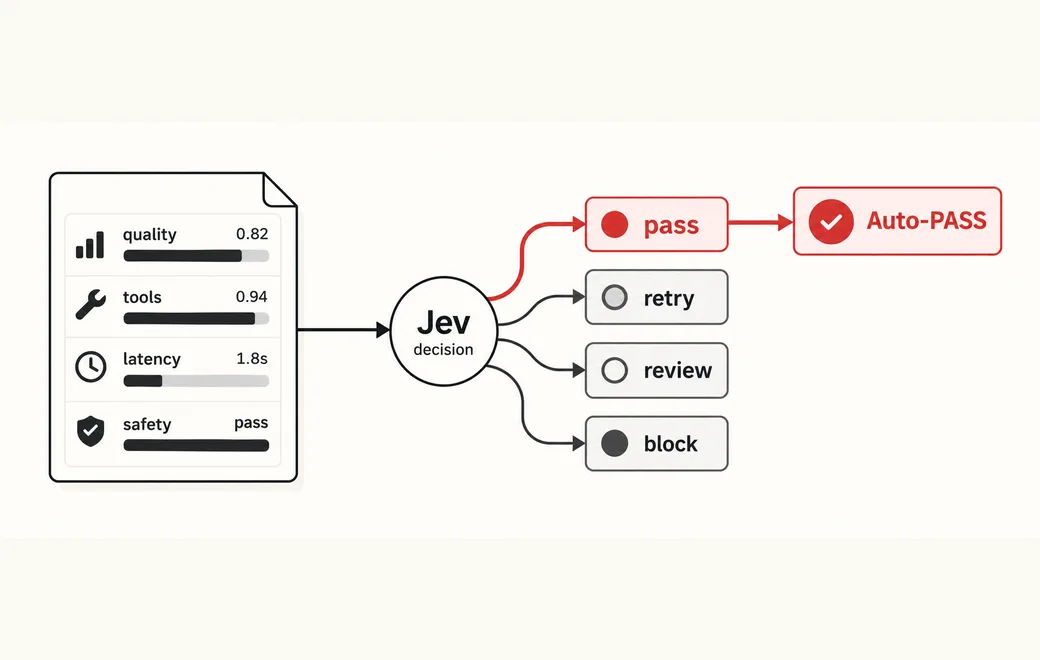
Who / when
Audience
- CI/CD owners who need typed gates on AI-generated test or eval runs
- QA and platform teams shipping LLM features behind merge policies
- builders who want evidence in, decision out—without asking an LLM "is this good enough?"
Triggers
- an AI eval or agent test run needs a merge-blocking gate, not a free-form summary
- quality, tool success, latency, and safety scores should become PASS / RETRY / REVIEW / BLOCK
- the LLM should produce evidence while a separate decision model applies judgment
- auto-PASS only when confidence is high and needs_human is false
The workflow
- 01Collect evidenceQuality, tools, latency, safetyInput
- 02Score strengthhigh / medium / lowJev
- 03Gate decisionpass / retry / review / blockJev
- 04Enforce in CIMerge, retry, hold, or failYour code
Question shape
{
  "decision": {
    "type": "choice",
    "instructions": "Decide the CI/CD gate for this AI test or eval run from the evidence only. Do not ask whether the run is \"good enough\" in free text—pick a typed action the pipeline can enforce.",
    "criteria": {
      "pass": "Evidence meets the policy bar (quality, tools, latency, safety); safe to proceed or merge",
      "retry": "Likely flaky or recoverable (timeouts, transient tool failures); re-run before human review",
      "review": "Ambiguous or borderline evidence; a human should inspect before merge",
      "block": "Clear policy miss—safety fail, severe quality drop, or hard SLA breach; fail the job"
    }
  },
  "evidence_strength": {
    "type": "score",
    "instructions": "How strong and consistent is the overall evidence for the gate you chose, ignoring the agent's own confidence wording.",
    "criteria": [
      "high",
      "medium",
      "low"
    ]
  },
  "needs_human": {
    "type": "noul",
    "instructions": "A human should review this CI gate before the pipeline allows merge or production promote."
  }
}
Gate policy
≥ 0.90
Auto-PASS only when decision is pass, evidence_strength is high, and needs_human is false. Auto-retry when decision is retry at high confidence.
0.65–0.90
Hold for human review; treat as review even if the top choice is pass. Do not merge yet.
< 0.65
Block the job; escalate when decision is block, evidence_strength is low, or needs_human is true.
Failure modes
Pre-launch checks before you trust auto-routing:
- Asking an LLM "is this test run good enough?" and parsing free-form prose in CI;
- Letting the same model both invent metrics and decide the merge gate;
- Auto-PASS on mid confidence because mean quality looks fine;
- Skipping BLOCK on a safety fail because latency and tools looked green;
- Retrying forever without escalating ambiguous REVIEW cases to a human;
FAQ
Why separate evidence from the CI gate decision?
An LLM or harness can score quality, tools, latency, and safety. That is evidence, not a merge policy. A separate typed Choice (pass / retry / review / block) plus Score and Noul lets code fail closed, retry flakiness, and hold for humans—without parsing "looks good enough" prose in the pipeline.
How should CI enforce PASS / RETRY / REVIEW / BLOCK?
Auto-PASS only on high-confidence pass with strong evidence and needs_human false. High-confidence retry re-runs within a budget. Mid band or review: hold the job and notify a human. Low confidence, block, or safety fail: fail the pipeline and escalate.
Can I bring my own API key?
Yes. Try the free demo above without signing in. To run it live on your own text, sign in with Google and connect a Flatkey or OpenRouter key (a quick test call runs when you save it). Manage or delete it anytime under Dashboard → BYOK. Keys are stored encrypted on the server, used only for runs you trigger, and never sent back to the browser. Need a Flatkey key? Get one for Jev 1.13 on Flatkey.
Is this the official TypeSafe Jev product page?
No. jev-llm.com is an independent research and practice site. Verify pricing, models and terms at the original TypeSafe sources.
Sources
Instead of asking an LLM: ‘Is this test run good enough?’ Build a decision layer: Test evidence ↓ Decision model ↓ PASS / RETRY / HUMAN REVIEW / BLOCK ↓ CI/CD action… PASS = 0.91, RETRY = 0.06, REVIEW = 0.03… The LLM produces evidence. The decision model applies judgment. The pipeline enforces the policy.
— @im_pranavkakde View the post on X →
Generate → Evaluate → Decide → Act. LLM/tests produce evidence; a decision model chooses PASS / RETRY / REVIEW / BLOCK; the pipeline enforces.
— @im_pranavkakde View the post on X →
Wire this gate with your own key
Bring your own key through Flatkey / OpenRouter. Keep exact checks in code.